Basic Queries
findMany
Returns an array of records matching the query.
const users = await r.users.findMany({ select: { id: true, firstName: true, email: true }, where: { email: { contains: '@example.com' } }, orderBy: { field: 'firstName', order: 'asc' }, limit: 10, offset: 0,});All options are optional. Without select, all scalar columns are returned. Without where, all rows are returned.
findFirst
Returns a single record or null.
const user = await r.users.findFirst({ where: { id: 1 },});// { id: 1, firstName: 'John', lastName: 'Doe', email: '...', ... } | nullfindFirst accepts the same options as findMany except limit and offset.
select
Controls which fields are returned. Set fields to true to include them.
const users = await r.users.findMany({ select: { id: true, firstName: true },});// [{ id: 1, firstName: 'John' }, ...]You can select:
- Scalar columns —
{ id: true, email: true } - Computed fields —
{ fullName: true } - Derived fields —
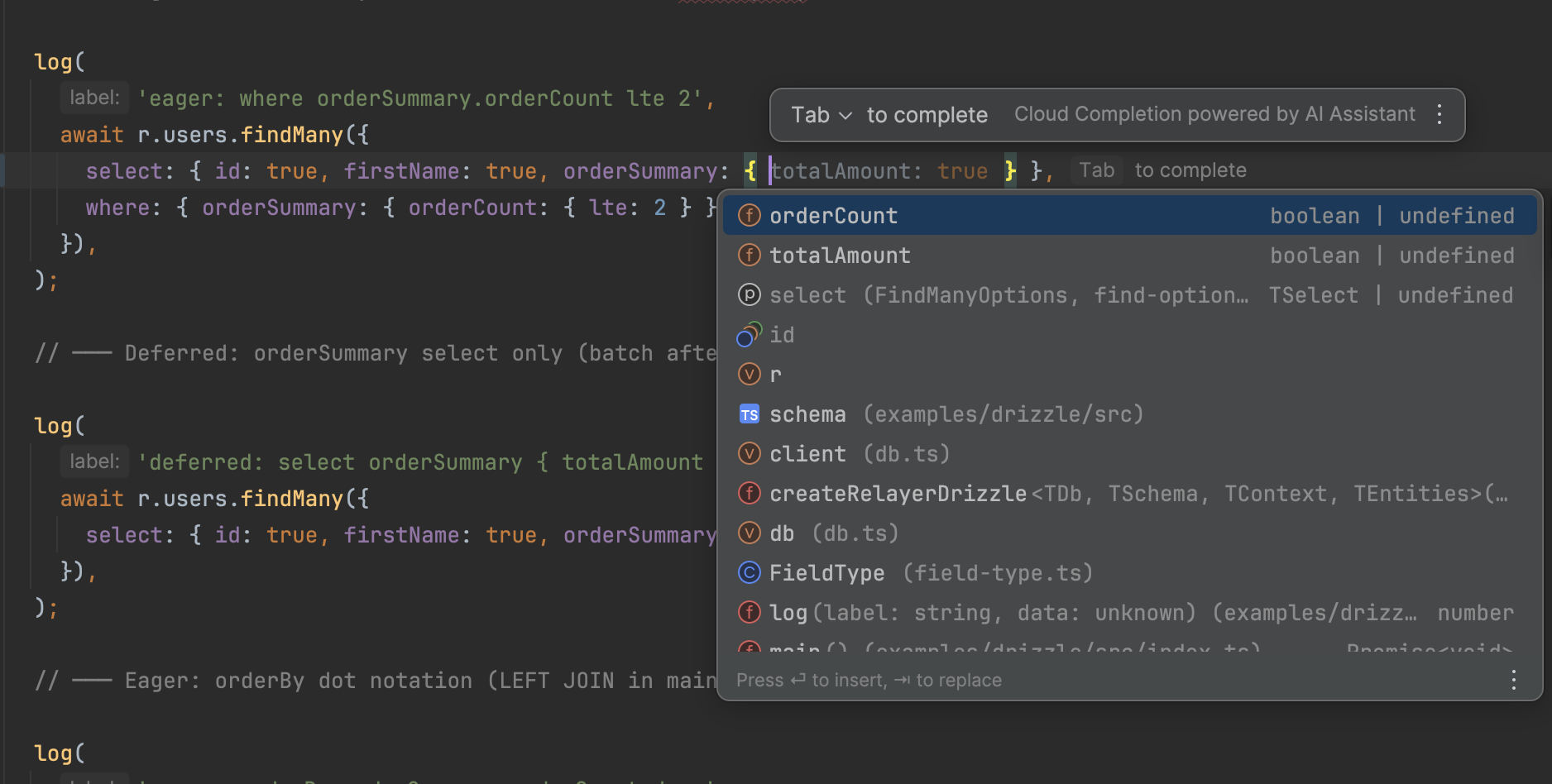
{ postsCount: true }or{ orderSummary: { totalAmount: true } } - Relations —
{ posts: { id: true, title: true } }(see Relations)
The result type is inferred from the select — you only get the fields you ask for.
where
Filters records. Accepts field names with operator objects, or shorthand equality.
// Shorthand equalityconst users = await r.users.findMany({  where: { firstName: 'John' },});
// Operator objectconst users = await r.users.findMany({  where: { email: { contains: '@gmail.com' } },});
// Multiple conditions (implicit AND)const users = await r.users.findMany({  where: {    firstName: 'John',    email: { contains: '@example.com' },  },});
See Operators for all available filter operators.
AND / OR / NOT
Combine conditions with logical operators:
await r.users.findMany({  where: {    OR: [{ firstName: 'John' }, { firstName: 'Jane' }],  },});
await r.users.findMany({  where: {    AND: [{ role: 'admin' }, { active: true }],  },});
await r.users.findMany({  where: {    NOT: { email: { contains: 'spam' } },  },});
They can be nested:
await r.users.findMany({ where: { OR: [{ firstName: 'John' }, { AND: [{ role: 'admin' }, { active: true }] }], NOT: { email: { contains: 'spam' } }, },});$raw
Escape hatch for custom SQL in where:
await r.users.findMany({ where: { $raw: ({ table, sql }) => sql`${table.firstName} ILIKE ${'%john%'} OR ${table.lastName} ILIKE ${'%doe%'}`, },});The $raw function receives { table, sql } — the same helpers available in computed field resolvers.
orderBy
Sort results by any field — scalar, computed, derived, relation, or JSON path.
// Scalar fieldconst users = await r.users.findMany({  orderBy: { field: 'firstName', order: 'asc' },});
// Computed fieldconst users = await r.users.findMany({  orderBy: { field: 'fullName', order: 'desc' },});
// Derived field with dot notationconst users = await r.users.findMany({  orderBy: { field: 'orderSummary.totalAmount', order: 'desc' },});
// Relation field -- automatic LEFT JOINconst posts = await r.posts.findMany({  orderBy: { field: 'author.firstName', order: 'asc' },});
// JSON path -- dialect-specific extractionconst users = await r.users.findMany({  orderBy: { field: 'metadata.role', order: 'asc' },});
// Nested JSON pathconst users = await r.users.findMany({  orderBy: { field: 'metadata.settings.theme', order: 'desc' },});
// Multiple fields (array)const posts = await r.posts.findMany({  orderBy: [    { field: 'author.firstName', order: 'asc' },    { field: 'title', order: 'desc' },  ],});
Relation ordering generates a LEFT JOIN on the related table. If multiple orderBy entries reference the same relation, the join is added only once.
JSON path ordering uses dialect-specific JSON extraction (->>'key' on PostgreSQL, json_extract() on SQLite, ->>'$.key' on MySQL). Values are compared as text. For numeric ordering on JSON fields, use a computed field instead.
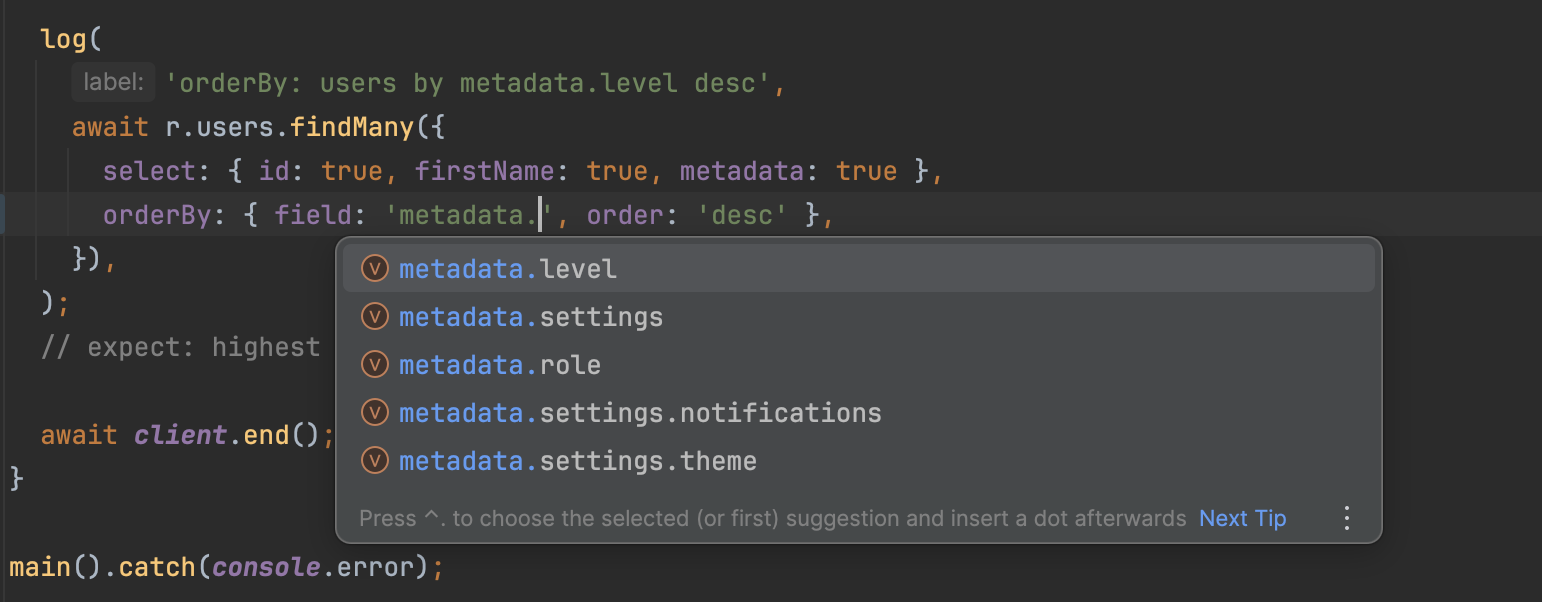
The field value is fully type-safe — TypeScript will autocomplete valid field names including relation columns, JSON paths, and dot-notation paths for object-type derived fields.
limit and offset
Paginate results:
const page = await r.users.findMany({ limit: 20, offset: 40, // skip first 40 records (page 3)});context
Pass per-query context to computed and derived field resolvers:
const users = await r.users.findMany({ select: { id: true, isMe: true }, context: { currentUserId: 42 },});See Context for full details.
Streaming (MySQL)
For large datasets, use findManyStream() to iterate over results without loading all rows into memory:
const stream = r.users.findManyStream({  select: { id: true, firstName: true, postsCount: true },  where: { email: { contains: '@example.com' } },  orderBy: { field: 'firstName', order: 'asc' },});
for await (const user of stream) {  console.log(user);}
findManyStream() accepts the same options as findMany(). Scalar fields, computed fields, and derived fields (both scalar and object-type) all work in stream mode.
Limitations
- MySQL only — Drizzle’s
.iterator()is currently stable only for MySQL. Throws on PostgreSQL and SQLite. - No relation loading — relations require batch queries, which are incompatible with streaming. Use
findMany()if you need relations.